
Delta County Court Records After Arrest
After a Delta County arrest, two record tracks exist. The Delta County Detention Facility creates the jail side: booking, custody status, bond processing, release, and transfer. The court side starts when the prosecutor files or pursues charges and the Colorado Judicial Branch opens or schedules a criminal case. The 7th Judicial District Attorney serves Delta County and makes state criminal filing decisions after law-enforcement reports are submitted.
Booking allegations and formal court charges can differ. An arresting officer's listed charge may be amended, reduced, dismissed, or replaced after prosecutor review. For custody and booking details, use Delta County jail inmate records. For booking photos, use the Delta County jail mugshots page. For formal charges, hearings, case status, and disposition, use court records after arrest through the judicial docket and court clerk.
Find Court Records After Arrest
The main online route is Colorado Judicial Branch dockets. The Delta County trial-court page adds local court context and clerk routing. Dockets may show hearing dates, case numbers, court location, case type, party names where public, charge language where displayed, bond or hearing activity, and disposition if the public record includes it. They should not be treated as a full police-report database.
- Identify the arrest date, defendant name, arresting agency, and any case or warrant number.
- Search the Colorado Judicial Branch docket tool using Delta County or 7th Judicial District filters when available.
- Use date ranges around the arrest date and the following days because early advisement or bond hearings can appear before later filings.
- Contact the Delta County court clerk when the public docket does not answer older, sealed, restricted, juvenile, or document-specific questions.
The manifest screenshot for Colorado Judicial Branch dockets shows the court calendar and docket path used for court records after a Delta County arrest.
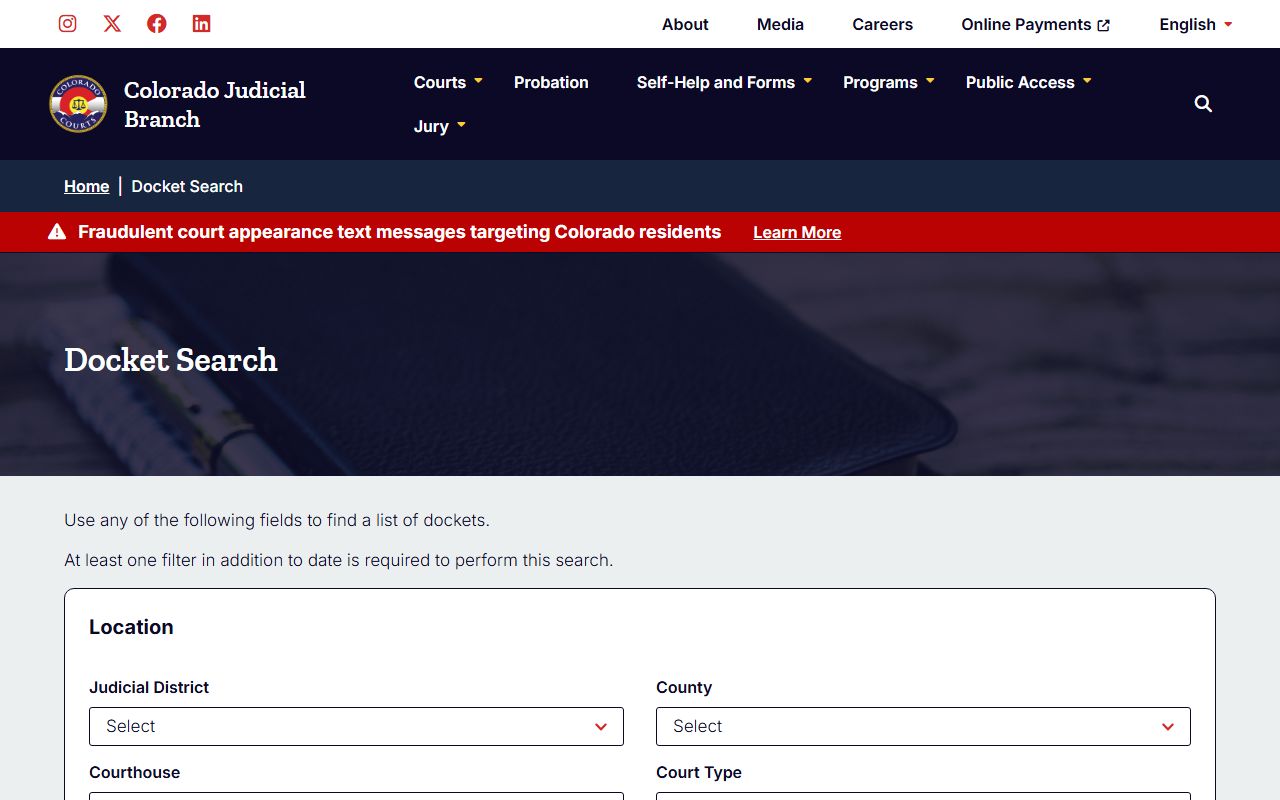
The docket search is the court route. It does not replace a jail phone call for live custody status.
Delta County Court Search Fields
The public docket interface is calendar and case oriented. It is not a booking database. Use defendant name or case number when available, and use date filters because dockets often revolve around hearing calendars. If the public search does not expose a document or older matter, the clerk is the next official channel.
| Field Label | Type | Required | Options / Format Notes |
|---|---|---|---|
| Court / county filter | Dropdown or page filter | Usually required for local narrowing | Use Delta County or 7th Judicial District where offered. |
| Name | Text | Optional depending on view | Search by defendant name where available. |
| Case number | Text | Optional | More precise than name when known. |
| Date / date range | Date or range | Often required for dockets | Dockets are often calendar-based. |
| Search / Submit | Button | Required | Runs the docket search. |
Charges Filed After Arrest
A court record after a jail arrest usually begins with a charging document or an early case event. The complaint, information, or indictment describes what the state is formally pursuing. A summons or citation can also create a court case without the person staying in jail. A warrant can start or revive a case if the person failed to appear or violated a court order.
| Document | What It Is | Delta County Use |
|---|---|---|
| Complaint | A charging document often used to start a criminal case near early appearances. | May reflect prosecutor or officer-filed allegations. |
| Information | A prosecutor-filed charging document used in many felony prosecutions. | Can follow required procedures after initial court action. |
| Indictment | A grand-jury charging document. | Less common than ordinary complaint or information filing for many local cases. |
| Summons or citation | A court command to appear without continued jail custody. | Can create court records even when no jail roster match appears. |
Delta County Charge Status
Charge status changes as the case moves through court. A pending charge is not a conviction. A dismissed charge is not the same as a sealed record. A reduced or amended charge may replace the original allegation. The docket and clerk channels are better sources for status than a jail booking note because the prosecutor and court control formal case updates.
| Status | What It Means |
|---|---|
| Pending | The charge has not been resolved by plea, dismissal, trial, or other final disposition. |
| Amended | The filed charge changed from an earlier version. |
| Reduced | A lower charge or lesser offense replaced the earlier allegation. |
| Dismissed | The court or prosecutor ended that charge or case. |
| Conviction | A final guilty plea, verdict, or other guilty finding, not the same as an arrest. |
| Disposition | The court result for a charge or case. |
Bond After a Delta County Arrest
Bond is part court order and part jail release process. The jail can confirm custody and release logistics, but the formal conditions come from the court, warrant, bond order, or judicial officer. Bond can change after first appearance. A listed amount also does not guarantee release if another warrant, parole hold, probation hold, federal hold, ICE detainer, or out-of-county hold blocks release.
| Bond / Hold Type | How It Works |
|---|---|
| Personal recognizance / PR | Release based on a promise to appear and court conditions. |
| Cash bond | Money must be posted as directed by the court or jail process. |
| Surety bond | A licensed bail agent or surety may post if the bond is surety-eligible. |
| No-bond hold | Ordinary posted bond is not available because of a warrant, order, or other hold. |
| Federal or ICE hold | Federal or immigration custody may affect release even if local bond is addressed. |
Warrants in Court Records
No official Delta County Sheriff's Office active-warrant search form was located in the official sources reviewed. A warrant can still be the reason a person enters jail, remains held after a new arrest, or returns to court after a missed hearing. Check the court docket and contact the court clerk for case-specific bench-warrant questions. For current custody, call the jail. People who believe they may have an active warrant should consider counsel before appearing at a law-enforcement counter.
- Arrest warrant
- A court or judicial authority for arrest based on probable cause or charging process.
- Bench warrant
- A warrant often issued after failure to appear or failure to comply with court orders.
- Detainer
- Another agency's request or hold that can affect release from the Delta County jail.
Charges vs Convictions
Delta County court records after arrest should be read with the presumption that an accusation is not a finding of guilt. A charge means the state is pursuing an allegation. A conviction means the court has accepted a guilty plea, returned a guilty verdict, or entered another qualifying guilty finding. Background-type decisions require lawful, accurate, and compliant sources.
| Charge | Conviction | |
|---|---|---|
| Stage | Accusation or filed allegation | Final guilty result or plea |
| Proof | Not proof of guilt | Entered through court process |
| Can Change | May be amended, reduced, or dismissed | May be appealed, corrected, sealed, or otherwise limited by law |
| Best Source | Docket, charging document, clerk | Docket, judgment, clerk, official criminal-history channel |
Sealed Court Records After Arrest
Colorado sealing rules can restrict public access to eligible criminal records, but eligibility depends on the case type, disposition, timing, and court order. The Colorado Judicial Branch sealing criminal records resource is the official self-help starting point. Sealing a case is not the same as deleting every third-party copy, and it does not mean all official agencies lose every internal record.
| Sealed | Expunged | |
|---|---|---|
| Public visibility | Restricted from ordinary public access by rule or order. | Generally more limited, often treated differently by statute. |
| Official access | Some agencies may retain limited lawful access. | Depends on the specific Colorado statute and record type. |
| Typical route | Court filing, eligibility review, and order. | Statute-specific process, often narrower than sealing. |
Restricted Delta County Court Records
Not every court record after a Delta County arrest is public in full. Juvenile matters, sealed cases, protected-party information, victim data, some mental-health or medical details, investigatory materials, and certain documents may be restricted. A public docket may show a hearing without providing every document. It may also omit or limit older records, sealed matters, or records subject to court-access rules.
Important: Docket entries and charges are not consumer reports and should be verified with the court before any serious use.